6

Earlier today, this question was posted and then deleted by the OP...

"Oh, that they should think so!"

What does this sentence structure mean?


After I'd laboriously composed an answer, I was somewhat irritated to discover I couldn't "post" it because the question had been deleted. So I've asked it again here, where I can post my own answer.

FumbleFingers
  • 62,560
  • 3
  • 82
  • 176
  • I vote to close this question because the *structure* alone cannot mean anything; it's only a full sentence that has a meaning. Note you wrote above: “What does this sentence structure mean?” I don't see a structure in your quotation anyway. –  Dec 07 '21 at 15:05
  • I think you mean you would ***like*** to closevote! Good luck with that! I assume you don't have enough rep to be able to actually see the original question. But note that ***What does this sentence structure mean?*** was copied verbatim from the original. – FumbleFingers Dec 07 '21 at 15:11
  • This doesn't change the fact that there is a problem with your question—I hope you see it. A *structure* is an abstract concept, a type of bracketing using certain parts of setence (or parts of speech) rather than specific words themselves. If you are really concerned with the quality of the site, consider improving your question. –  Dec 07 '21 at 15:17
  • *"Arguably this question isn't a good fit for a learners site, but we **were** where we **were**"* – FumbleFingers Dec 07 '21 at 15:21
  • My point is not about whether this question is good/bad for *a learner's site* or about where you were, but about its ***understandability in general***. Frankly, I simply don't think it's clear, and, given your other answer so far, I have no doubt you see it, too. –  Dec 07 '21 at 15:29
  • The question (and answer) were "understandable" enough to engage a couple of *exceptionally* articulate users here *(J.R & StoneyB)* in discussion / comments, and there are a total of 14 upvotes on this page (no downvotes *yet!* :) But I think you're just being misguidedly pedantic - any dictionary will confirm that ***structure*** and ***construction*** can be synonymous, and references to [***the meaning of this construction***](https://www.google.com/search?tbm=bks&q=%22meaning+of+this+construction%22) are common as muck in grammar / linguistics texts. – FumbleFingers Dec 07 '21 at 15:39
  • In you case, we see just a sentence, whereas the term *construction* is very generic and can mean too many unrelated things. There is even a construction going on at my neighbour's flat. As for *exceptionally articulate users here*, you probably mean users who exceptionally cannot find a better application of their lives than to waste their time at Stackexchange. As for the downvotes, well, I can help with that, so if you insist… I hope you don't mind, sir. –  Dec 07 '21 at 15:56

1 Answers1

8

Arguably this question isn't a good fit for a learners site, but we are where we are. First of all, note...
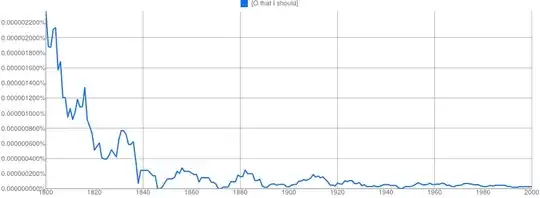
...showing that this dated/poetic/archaic construction has little relevance to contemporary English.

The exclamation O (more commonly transcribed as Oh today) can have a wide range of meanings. That MW list is only partial - it doesn't even include the very common use as a hesitation device, for example - but the first definition is what applies to OP's example, where it's being used to express surprise.

Effectively therefore, we can equate Oh here to It is surprising - followed by a "that" clause specifying exactly what is surprising. We can thus rephrase the utterance as...

That they should think so is surprising.
...more simply, noting this earlier ELL question explaining that should is optional in such contexts...
That they think so is surprising.
...or even more simply...
They think so, which is surprising.

In the example in an earlier question on Proper usage of 'to do so', the "referent" of so (what it actually refers to) is explicitly specified in the utterance. In OP's example here, it's not - so we can't even say for certain whether it means that they think in a certain way, or that they believe a certain thing to be true. Probably the latter, but in practice the precise "thing believed" would be clear in context.


The only aspect of this construction relevant to current English concerns potential distinctions between...

Q: "Would you say this is a good answer?"
A1: "I think so."
A2: "I should think so."

As mentioned above, "should" is effectively optional here. As so often happens in such situations, native speakers naturally look for some reason why the speaker chose to add an apparently unnecessary word (particularly in this case, since #A is an extremely common thing to say).

It would be misleading to suggest there's any specific meaning to should in my final example there. The most credible "literal" sense would be "I ought to think that [but for some reason I don't]", but in practice that's an unlikely thing to want to say. Usually it's either a way of adding hesitancy (I might think that if I were to think about it at all), or emphasis (often with think stressed, and an exclamation mark after so, giving the sense of "I very definitely do think that!").

FumbleFingers
  • 62,560
  • 3
  • 82
  • 176
  • 1
    Sometimes that "surprise" is mingled with appreciation or admiration, as in: _Oh, what a thorough answer!_ – J.R. Feb 24 '14 at 15:21
  • @J.R.: Oh, absolutely! But I did point out that the MW definition I linked to was *only partial*. Oh - and I still think that *today in speech* very likely the most common usage is simply as a "hesitation device". *"Oh, I'm not sure if I could actually back that up"* - but I *am* sure it's an exclamation of surprise in OP's example (regarding which I guess I can afford to be sure now, since it's actually become ***my*** example! :) – FumbleFingers Feb 24 '14 at 15:34
  • 1
    +1 But *Oh!* might also indicate *How it distresses me that they should think so!* or *How deeply I wish that they should think so!* – StoneyB on hiatus Feb 24 '14 at 17:19
  • @StoneyB: Indeed. Your first possibility being in line with the first definition of **Oh** in my MW link *(used to express surprise, happiness, **disappointment, or sadness**)*. The second being perhaps also in line with my point about the "literal" sense of *should* - i.e. *"They **ought** to think that [which would please me, but for some reason they don't, which saddens me]"* – FumbleFingers Feb 24 '14 at 17:29
  • @FumbleFingers I was thinking in the second of *should* being a volitive subjunctive. – StoneyB on hiatus Feb 24 '14 at 19:07
  • @StoneyB: Yes - I didn't know the actual term *volitive subjunctive* (in context I can infer it, but I've just googled to be sure), but that's what I understood to be the sense of your second example. Maybe it's "stretching" a bit (hence "*perhaps* in line with...") but *volitive* ("one's will, what one wants to be the case") seems to me to be pretty close to what I called the "literal" sense of *should = ought*. Maybe it depends how much one identifies one's own self (and will) with "objective, absolute" moral righteousness! – FumbleFingers Feb 24 '14 at 21:56
  • @FumbleFingers No reason you should know the term *volitive subjunctive* since I made it up on the spur of the moment! – StoneyB on hiatus Feb 24 '14 at 22:04
  • @StoneyB: Maybe so, but I still have [the link open](http://people.bu.edu/tylert/Latin/subjunctives.html) from which I cut&pasted *"one's will, what one wants to be the case"*, so it's obviously got legs! – FumbleFingers Feb 24 '14 at 22:33
  • 1
    @FumbleFingers Hmm... Looks like I should have called it an *optative subjunctive* :) – StoneyB on hiatus Feb 24 '14 at 23:06
  • What a wonderful explanation. I think this Q is related to the one I asked before: http://ell.stackexchange.com/questions/24938/two-usages-of-should-have-done Is the "should have thought" in my post the backshifted form of your putative "should think"? or just a way of further distancing one's thoughts? – Kinzle B Sep 26 '15 at 08:08
  • @Kinzle: *I **should have thought it was** obvious* that in this sentence I'm "distancing" myself from the assertion more than would be the case if I'd started with *I **think it's** obvious*. But as pointed out by comments/answers to your linked question, using ***should*** rather than ***would*** is pretty dated/starchy (particularly for AmE speakers), so the net effect is supercilious / haughty rather than formal / deferential. – FumbleFingers Sep 26 '15 at 16:09
  • So it would be considered as formal or deferential back in pre-1800s? Jimsug says _should_ could express _propriety_. What's meant by _propriety_? meaning appropriateness? @FumbleFingers – Kinzle B Sep 26 '15 at 17:02
  • @Kinzle: Yes. If I say *You should respect your parents*, I probably mean you *ought to* (because it's *right, proper, correct* to do so). But if I say *You should have seen what happened at the pub last night* there's no particular implication of "correctness" - I probably just mean something remarkable happened (which I think you'd like to know about, so probably I'm about to give you all the details). – FumbleFingers Sep 27 '15 at 16:05
  • I'm wondering if it were rephrased as "Oh, I wish they should think so!" would it be semantically equivalent to the exclamation in question? – Lucian Sava Dec 07 '16 at 21:55
  • It really depends on the exact full context. As I pointed out, OP's exclamation can be seen as equivalent to *They think so, which is surprising.* That interpretation would normally imply the speaker is *unpleasantly* surprised (but it might sometimes imply he's *pleased*). On the other hand, the same utterance could imply that it *would* be surprising if they did in fact think that way (as a hypothetical scenario), in which case it's much more likely that the speaker means he would be *pleasantly* surprised (i.e. - that's what he would *wish* to be the case). – FumbleFingers Dec 08 '16 at 14:38