13

I have never come across any verb that takes its first letter in capital. It generally happens in nouns. I have read many books and in our schools also, the rules of making letter capitals is quite clear and understood. I have never come across any book that defines capitalization of a verb. Nevertheless, here is the verb that is in capital!

Christianize (v) - two meanings there.

I completely understand the meaning but why the verb has taken a capital letter? Is this the special and only case?

Is there any rule for a verb to have its first letter capital?

Additional but useful note: When Google has become immensely popular and the verb has formed from its noun, mind it, we changed 'G' to a small letter. You don't Google something, you google it.

Maulik V
  • 65,222
  • 105
  • 299
  • 447
  • 1
    I believe that words derived from proper nouns retain their capitalization. I usually see this with adjectives, not verbs (like _Victorian, Shakespearean, Euclidean, Rubenesque, Christmastime, Marxist_ and _Romantic languages_), but I didn't think part-of-speech affected the rule. Still, I'm at a loss to think of another verb! I tried _Anglicanize_ (not in most dictionaries) and _vulcanize_ (takes lower-case), before finally settling on [Hebraize](http://www.collinsdictionary.com/dictionary/english/hebraize), which isn't a great example, I'm afraid. Maybe not so many proper nouns become verbs? – J.R. Apr 07 '14 at 19:36
  • @J.R. What about _italicize, bohemian, quixotic, china, guinea pig, utopia_? – Helix Quar Apr 08 '14 at 02:58
  • @helix none of them take the capital letter as first. – Maulik V Apr 08 '14 at 04:30
  • @helix - Good examples. As can be expected, English is inconsistent at best. :^) – J.R. Apr 08 '14 at 09:44

3 Answers3

8

You may think that if the root word Christian is capitalized then Christianize must be capitalized too. However, capitalization is a matter of usage and it tends to change over time.


Style guides have disagreeing opinions.

From the U.S. Government Printing Office Style Manual 3.33 Religious Terms:

Words denoting the Deity except who, whose, and whom; names for the Bible and other sacred writings and their parts; names of confessions of faith and of religious bodies and their adherents ... are all capitalized.

Christian; also Christendom; Christianity; Christianize

On the other hand:

From the Chicago Manual of Style

But do not capitalize verbs derived from proper names:

to boycott, to fletcherize, to christianize, to pasteurize.


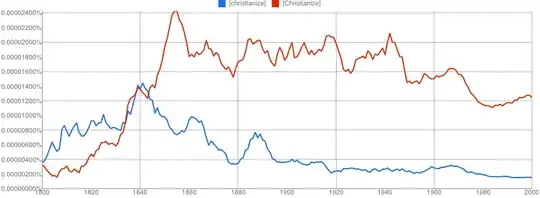
The question is: who's winning?

Google NGram Viewer which shows the capitalized version has consistently been more common since about 1840

Helix Quar
  • 1,790
  • 18
  • 27
  • *I would argue that capitalization is just matter of style. Only a few centuries ago, some people capitalized almost all nouns. The word Christanize is no exception.* - I had no problem if Christianize as a **noun** is capitalized. My question is capitalization of the **verb** Christianize. – Maulik V Apr 08 '14 at 11:28
  • 1
    @MaulikV I think I may have misrepresented my point— *editing to clarify*. – Helix Quar Apr 08 '14 at 16:03
  • 1
    @MaulikV I'm a little confused because as far as I know, *Christianize* is always a verb, isn't it? (Although, admittedly, I'm not very familiar with the word.) – Damkerng T. Apr 08 '14 at 16:33
  • @DamkerngT. It is always a verb but the question is **why a verb takes its first letter capital.** Have you ever come across a verb that way? – Maulik V Apr 08 '14 at 16:36
  • If it's always a verb then I would follow the style manual I had to use. (helix provided two manuals of style already.) As for why or its etymology, though it's a part of your question, I'm not very concerned. – Damkerng T. Apr 08 '14 at 16:40
  • @MaulikV Addendum: ["Capitalization of proper nouns used as verbs"](http://english.stackexchange.com/a/79041/24485) – Helix Quar Apr 08 '14 at 16:41
  • @helix thank for the link but *Christianize* was **never** a noun I guess. Also, he has the same confusion and does not answer it - *...and especially seeing how English, in general, **simply does not capitalize verbs** except at the beginning of a sentence* – Maulik V Apr 08 '14 at 16:47
  • 4
    English, in general, doesn't capitalize verbs, but words related to diety (which would include _Christ_) provide exceptions to capitalization rules. From Wikipedia: "Many European languages traditionally capitalize nouns and pronouns used to refer to God, including references to Jesus Christ (reverential capitals): _hallowed be Thy name, look what He has done_. Some English authors capitalize any word referring to God: _the Lamb, the Almighty_; some capitalize 'Thy Name'. These practices have become less common in the 20th and 21st centuries." This is just a verb stuck in a gray area. – J.R. Apr 08 '14 at 17:59
5

This is not the "special and only case". Oxford and Merriam-Webster both list Africanize/Africanise but not africanize/africanise. I'm sure there are many more such cases; this just happens to be the first one that I thought of.

4

Pre-1923 usage is mixed on whether to capitalize or not. Googlewhacking Gutenberg https://www.google.com/#q=christianize+site:gutenberg.org shows a definite mix of upper and lower case forms of the verb. I have not tried to further break down results by date of original publication, so it may have faded in or out of use.

WRT your G/google example I would note that you can "google" something using Bing (though few do) but you cannot Christianize people by preaching out of (say) a Torah or Koran. In that sense it is specific to Christ and his (His?) religion.

K.A.Monica
  • 1,083
  • 5
  • 9
  • I first noticed examples of the generalization of the verb *google* more than ten years ago, but my current sense is that, for many (most?) speakers, it still refers to searching specifically with Google. –  Apr 08 '14 at 02:57
  • @snailplane Certainly, if you say *google it* it'll mean searching on Google only. Or else, to stay clear, I prefer *search on the Internet*. But there too, 'G' becomes 'g'! – Maulik V Apr 08 '14 at 04:32