-1

Where exactly should I use "shall"/other tense in this agreement?
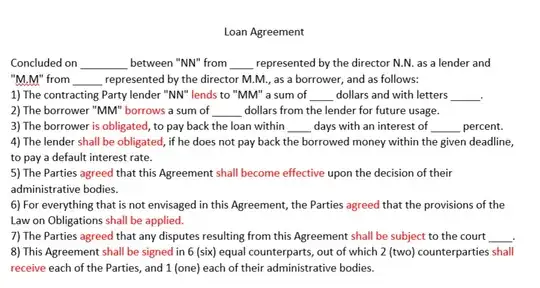
Text

  • I know where "shall" is supposed to be used theoretically, but I want concrete solutions to the clauses in the given example. – theguyfromtheworld Jul 19 '21 at 18:57
  • "I want concrete solutions" It sound rather like you want us to answer the questions for you... Perhaps you'd do better to do your best, make mistakes and learn from them. There are 12 separate questions here. Which ones do you have particular difficulty with. – James K Jul 19 '21 at 20:39
  • @JamesK I read the question like this is a boilerplate loan agreement with certain verbs highlighted for our benefit. The OP is asking about the pattern to the highlighted verbs and why some have "shall" while others just the bare verb. – gotube Jul 20 '21 at 02:52
  • I want to know which tenses should I use at each of the red-marked portions, for example whether I should use "is obligated" in 3) (like it already is), or maybe change it to "shall be obligated" or something else. In 7), whether I should use "agreed" (as it is) or "shall agree" or "have agreed" or something else. The same goes for all other red-marked portions. And possibly, an elaboration on why I should use the particularly suggested tense there. Basically, I want the red-marked places corrected where they're wrong. – theguyfromtheworld Jul 20 '21 at 07:09
  • The question is **too broad**, it is not a single question but a request for proofreading several sentences. The title is misleading because it does not represent what you are asking in the body. Furthermore, images cannot be read by screen readers, copied and pasted into answers nor can they be searched in the archives. – Mari-Lou A Jul 20 '21 at 11:20

1 Answers1

0

In "legalese", including in this loan agreement, "shall" is the preferred modal verb to refer to the future. Replace "shall" with "will" as you read and the meaning might become clearer.

For example, clause 3 says, "The borrower is obligated to pay back the loan..." while clause 4 says, "The borrower shall be obligated, if..., to pay a default interest rate." This means as soon as this agreement is signed, the borrower immediately is obligated to repay the money by the deadline, and the lender will have to pay interest only after the borrower doesn't pay it back.

(Incidentally, it makes no sense to me why a lender would have to pay interest if the borrower doesn't repay, but I'm no lawyer)

gotube
  • 32,728
  • 6
  • 46
  • 110
  • I need corrections, read my other reply. Also, excuse my mistake, but it should be "borrower" instead of "lender" there, that's why you're confused. – theguyfromtheworld Jul 20 '21 at 07:10
  • If you want corrections, then you're asking too many questions at once for this forum – gotube Jul 20 '21 at 16:25