19

I know "It's raining" and "It's snowing" are commonly accepted English phrases. Now does the same form apply to other forms of precipitation?

Are these normal English expressions?

If not, how does one describe the state of these falling currently?

StoneyB on hiatus
  • 173,630
  • 13
  • 257
  • 453
SF.
  • 9,960
  • 8
  • 45
  • 77
  • 2
    Graupeling, despite its listing in wikipedia, is so exceedingly rare that using it in general conversation is not likely to be understood at all. – Mark Beadles Jan 27 '13 at 18:18
  • "It's sleeting" and "It's hailing" are perfectly natural, but will also be just as likely to be referred to in noun form when describing current outside conditions: "The hail is coming down hard", I can't see through the windshield because the sleet is so heavy" – Mitch Jan 27 '13 at 23:21
  • 5
    Graupeling? Wow, 37 years of speaking English and I've never heard that word before! – Groky Jan 29 '13 at 23:51

2 Answers2

10

I have to post this because the only existing answer is misleading. Here's a more relevant NGram...
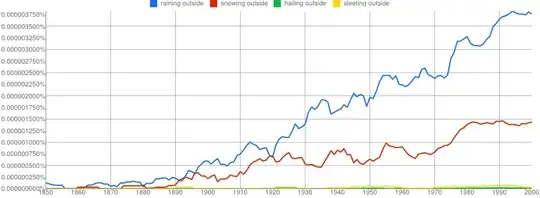
enter image description here

The reality is native speakers don't often say it's hailing/sleeting, even allowing for the fact that hail and sleet are less common that rain and snow. If you ask someone on the phone "What's the weather like?", they're more likely to reply with some alternative to avoid using those words as verbs - for example...

There's a hailstorm right now, or
It's snowing - well, more like sleet, actually.

That's not to say hailing or sleeting would mark you out as a non-native speaker - but it certainly wouldn't encourage people to think you are one.

As for graupeling, I would suggest that's a virtually unknown German term. Speaking as an Englishman, obviously I talk about the weather all the time, but I didn't even know the word until now.


EDIT: I originally answered because the earlier answer used a misleading search term (as an isolated word, hailing is far more likely to be used to mean calling, so most instances are "false positives"). Obviously the main reason for different levels of usage is hail is uncommon relative to snow and rain.

Possibly because it's relatively uncommon (in UK SE we only get a few hailstorms a year, that rarely last long), I perceive it hailed earlier as very slightly "marked" compared to there was a hailstorm earlier. By the same token, I myself would tend to say "There was thunder" rather than "It was thundering".

The verb forms to hail (and perhaps to a lesser extent to sleet) aren't particularly unusual. In fact they're probably used more often in creative fiction than actual weather patterns would justify, for the sake of atmospheric effect. The "strangeness" of using these verbs in speech may depend on local climate.

FumbleFingers
  • 62,560
  • 3
  • 82
  • 176
  • Can you explain how you think ctype's answer is misleading? (note first that the OP is asking if it is possible, not about relative frequency) also, it is unnaturally specific to require '... outside'. – Mitch Jan 27 '13 at 22:32
  • @Mitch: Erm... It's misleading firstly because the first three words are simply not true, and secondly because he supports the answer by linking to an ngram where we can be quite certain the vast majority of the instances of *hailing* are *loud calling* - nothing to do with weather, as commented by S.F. – FumbleFingers Jan 27 '13 at 22:37
  • 1
    ...also (perhaps this needs to be raised in meta) I think it's not helpful for a *Learners* site to make much of linguistic forms which do occur, but are uncommon. – FumbleFingers Jan 27 '13 at 22:40
  • 1
    OK, but 'it is hailing' is very natural to me, a native speaker (exactly the kind of perspetive the OP wants), despite it not being as common as 'it is snowing'. Lesson: interpreting data from nGrams is difficult. – Mitch Jan 27 '13 at 23:17
  • 1
    Most people wouldn't specify that is was snowing outside, because it does not normally snow inside. Additionally, _hailing_ is fairly common in the United States. – ctype.h Jan 28 '13 at 01:44
  • 1
    There may be a US-UK split here, judging by the commentary. – Mark Beadles Jan 28 '13 at 02:30
  • @ctype.h: Obviously *most* usages won't involve "outside", but *some do*. Equally obviously, it's vanishingly unlikely there'd be any difference in the *relative ratios* of usages for each term. The word "outside" was included to screen out the false positives in your link. If you hear *hailing* very often, perhaps you live in an area with unusual weather. We get all sorts in the UK, but hail only on a few days most years. And it doesn't usually last long enough for many people to say *"Come and look! It's hailing!"* – FumbleFingers Jan 28 '13 at 02:31
  • 2
    `Speaking as an Englishman, obviously I talk about the weather all the time, but I didn't even know the word until now.` :) +1 for this! – Mistu4u Jan 28 '13 at 05:37
  • @Mark Beadles: I've edited to reflect the probability (imho) that it's not so much a UK/US split, as a matter of how often you might have reason to use the words, which depends on your local clime. I can't quite make up my mind on that because it seems to me *sleeting* is less common than it ought to be. I think *hailing* gains familiarity simply because it's a commonplace cliche for bad weather in fiction, not because it hails much more than it sleets (which sounds a rather odd thing for me to write, on account of *both* verbs). – FumbleFingers Jan 28 '13 at 05:47
  • 1
    @FumbleFingers Yes, that could be. Here in the midwestern US hail is not uncommon, so "it's hailing" seems normal to me. – Mark Beadles Jan 28 '13 at 12:27
  • 1
    @Mark: I think the fact that our example is *present continuous* has a bearing. I have no problem as such with *"it's hailing"* - but, for example, *"I hope it doesn't hail tomorrow"* seems definitely "odd" to me (partly, I suppose, because it's unlikely I've *ever* heard it said). Even more odd would be *"It'll probably sleet tonight"* (or indeed, *thunder*). But I wouldn't think there was anything at all unusual about those constructions with *rain, snow*. – FumbleFingers Jan 28 '13 at 14:57
8

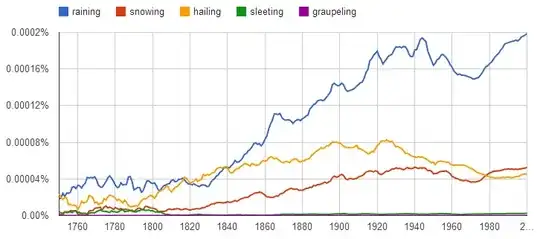
Hailing is frequently used. Sleeting is also used, but is less common. Graupeling is extremely rare and should probably be avoided.

The reason hailing may be less common than raining or snowing is that hail does not fall as frequently as rain or snow. However, saying, "It's hailing." sounds very natural to native speakers. Personally, I have never heard anyone say, "It's sleeting." I never heard of graupel until reading the above question. Most of the people I know would probably call it hail.

See Google Ngram Viewer (1750-2000): raining, snowing, hailing, sleeting, graupeling:

Ngram

ctype.h
  • 4,013
  • 1
  • 25
  • 44
  • nGram of "Hailing" alone isn't telling much; Usage like "The centurions are hailing the Caesar" is probably more frequent than weather-related. – SF. Jan 27 '13 at 12:23
  • 1
    @SF. I didn't think about the other usage, but saying, "It's hailing" when there is a hailstorm is quite common, at least where I live. – ctype.h Jan 28 '13 at 00:12
  • It is common here too. – Gaff Feb 03 '13 at 19:20
  • I always thought the word sleeting was incorrect (I've never heard anyone use it) and have formed my sentence to use the word sleet. From now on I shall use the word sleeting more often! – Ian Stanway Dec 12 '14 at 14:53